When people first start API testing, we usually teach them something like this:
Send a request.
Check the response.
Validate the status code.
Maybe validate the JSON.
Done.
And there is nothing wrong with that.
Everyone needs to start somewhere.
But after working around software testing for a long time, I think API testing becomes much more interesting when we stop thinking about APIs simply as technical endpoints.
An API is really a promise between systems.
One system says:
Give me this information in this format, and I will behave in this way.
That promise is where some of the most important testing actually sits.
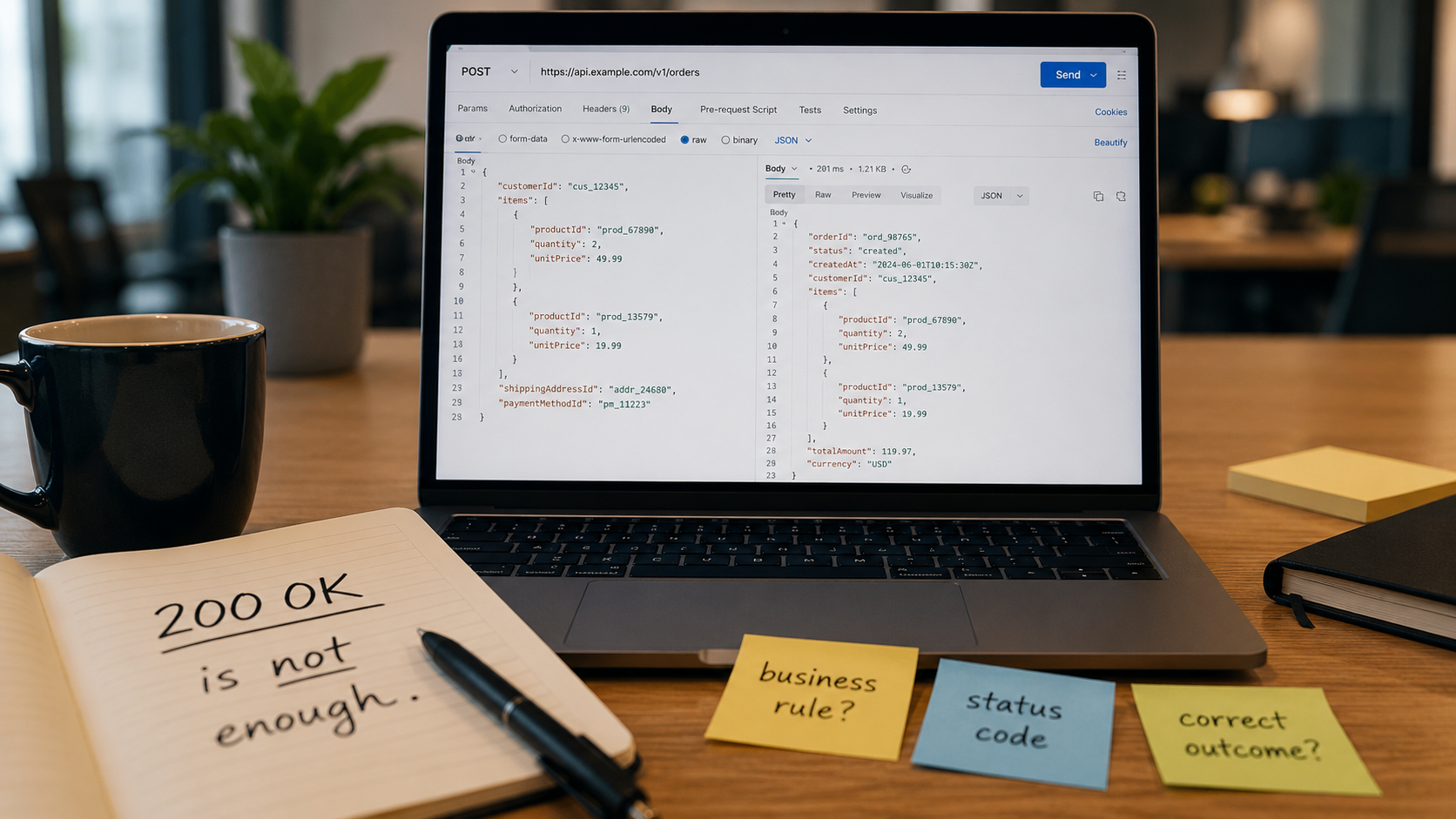
200 OK can still be completely wrong
Probably the easiest mistake in API testing is becoming too comfortable with successful responses.
We see:
Status: 200 OK
Response time: 180ms
Schema: Valid
Everything looks good.
But imagine the business rule says:
Customer account balance: $500
Requested purchase: $700

Expected:
Transaction rejected
And the API returns:
{
  "status": "SUCCESS",
  "transactionId": "TX12345"
}
HTTP 200.
Perfect JSON.
Fast response.
Completely wrong.
That is why I don't think a status code tells us much about quality on its own.
It tells us that the technical conversation happened.
It does not necessarily tell us that the business outcome was correct.
That distinction matters.
The UI can look fine while the API is already broken
This is one reason I have always found API testing so valuable.
UI testing shows us what the customer can see.
API testing often shows us what the system actually believes.
There can be a big difference.
Imagine the screen says:
Order successfully created.
Beautiful.
Green tick.
Confirmation page.
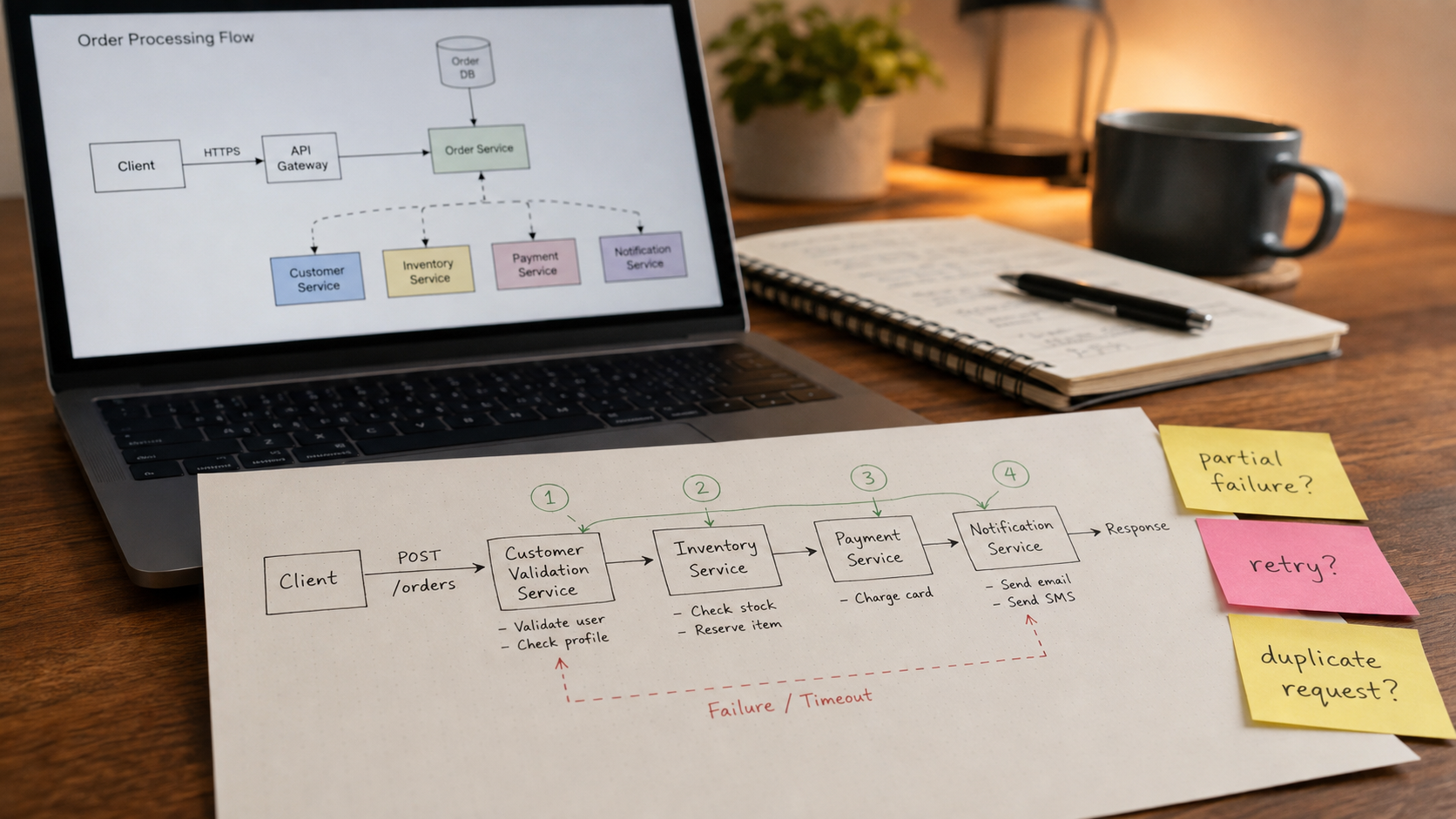
But behind that screen:
Order API           ✓
Payment API         ✓
Inventory API       ✗
Notification API    ✓
Now what?
Did the transaction succeed?
Did it partially succeed?
Should it roll back?
Should inventory retry?
Should somebody be alerted?
What should the customer see?
That is where API testing stops being about sending requests and starts becoming proper Quality Engineering.
APIs expose the business without the decoration
A UI has buttons, forms, animations, layout and user journeys.
An API removes most of that.
You get much closer to the actual business logic.
For example:
POST /orders
looks simple.
But behind that one request might sit:
Validate customer
       ↓
Check product
       ↓
Check inventory
       ↓
Calculate pricing
       ↓
Apply discount
       ↓
Authorise payment
       ↓
Create order
       ↓
Reserve stock
       ↓
Trigger fulfilment
       ↓
Send notification
Suddenly one endpoint is not really one test.
It is a collection of business decisions.
That is why API testing can become incredibly powerful even without hundreds of complicated test cases.
The important thing is asking the right questions.
The interesting tests are usually not the happy path
Anyone can test:
Valid request
      ↓
200 OK
Useful.
But not especially interesting.
I would rather know what happens here:
Valid customer
Valid product
Invalid price
or:
Valid request
Payment succeeds
Inventory update fails
or:
Same transaction submitted twice
or:
Correct payload
Expired authentication token
or:
Valid request
Downstream service responds after 29 seconds
Those situations tell us far more about how robust a system really is.
The happy path proves that the system works when everything behaves.
Good API testing asks:
What happens when something doesn't?
Boundary testing becomes much easier at the API layer
This is another reason I think API testing is such a useful skill for somebody starting a QA career.
You can learn a huge amount about testing without needing a complicated browser automation framework.
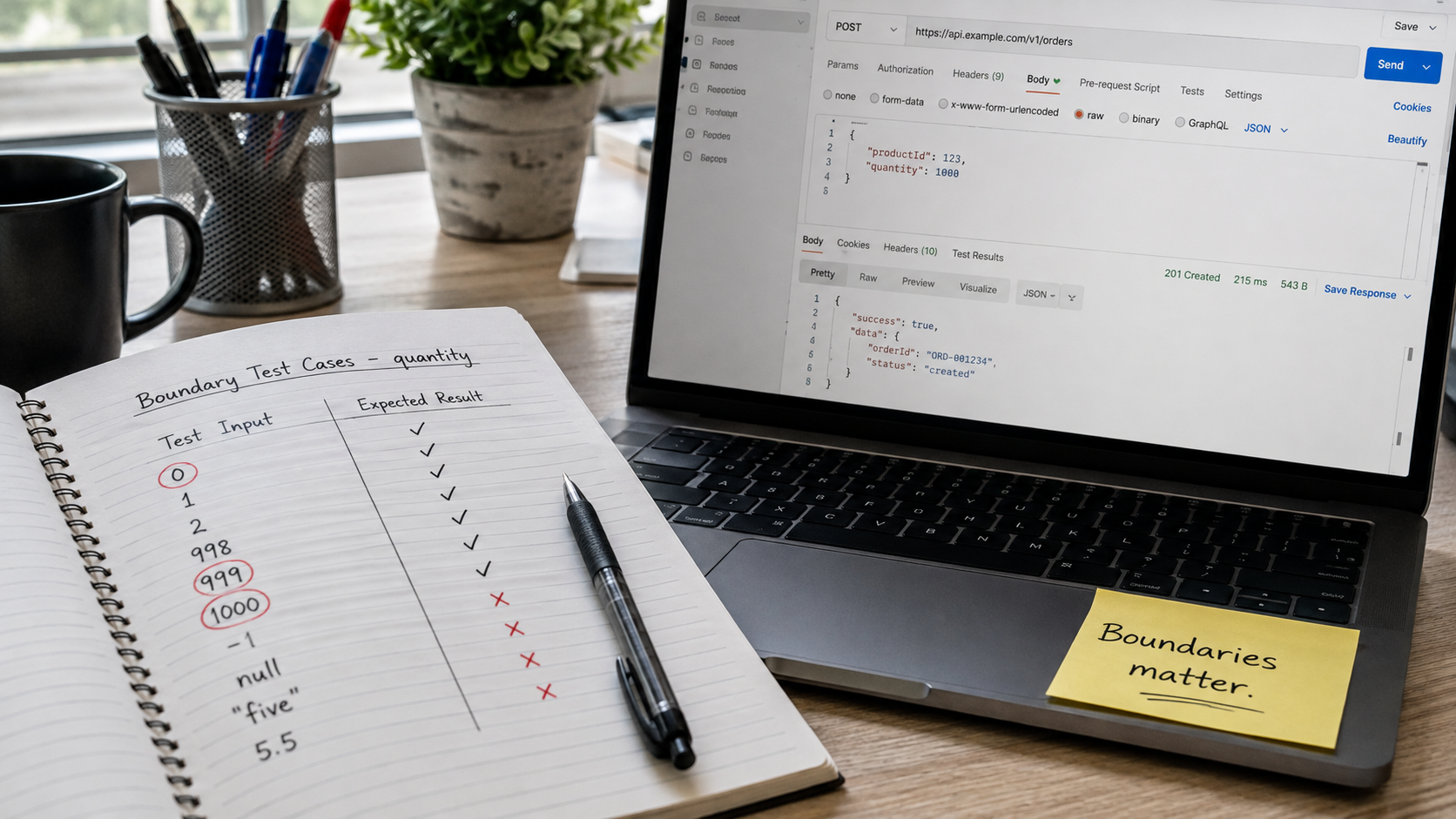
Take something simple:
{
  "quantity": 5
}
Requirement:
Quantity must be between 1 and 999.
Immediately I am thinking:
0
1
2
998
999
1000
-1
null
"five"
5.5
very large number
missing field
That is testing.
The tool is almost irrelevant.
Postman.
Bruno.
curl.
Playwright.
REST Assured.
Whatever.
The quality comes from the questions, not from the tool.
That is one thing beginners sometimes miss because we naturally focus on learning software first.
Knowing where to click in Postman is useful.
Knowing why you are sending a particular request is much more useful.
API testing teaches you how systems actually work
This may be one of the most underrated benefits.
When you start testing APIs properly, you naturally start asking questions like:
What service owns this data?
Where does authentication happen?
Who calculates this value?
What happens downstream?
Is this operation synchronous or asynchronous?
What happens if the same request arrives twice?
Who is responsible for retrying?
What gets written to the database?
What does another system receive?
Those questions gradually build architecture knowledge.
You stop seeing:
Screen A → Screen B
and start seeing:
Client
   ↓
API Gateway
   ↓
Service
   ↓
Database
   ↓
Message
   ↓
Another Service
For a tester, that is a big shift.
Because once you understand how the system communicates, you start seeing risks that are difficult to notice from the UI alone.
Contract testing is really about trust
The word "contract" sounds technical.
The idea is actually simple.
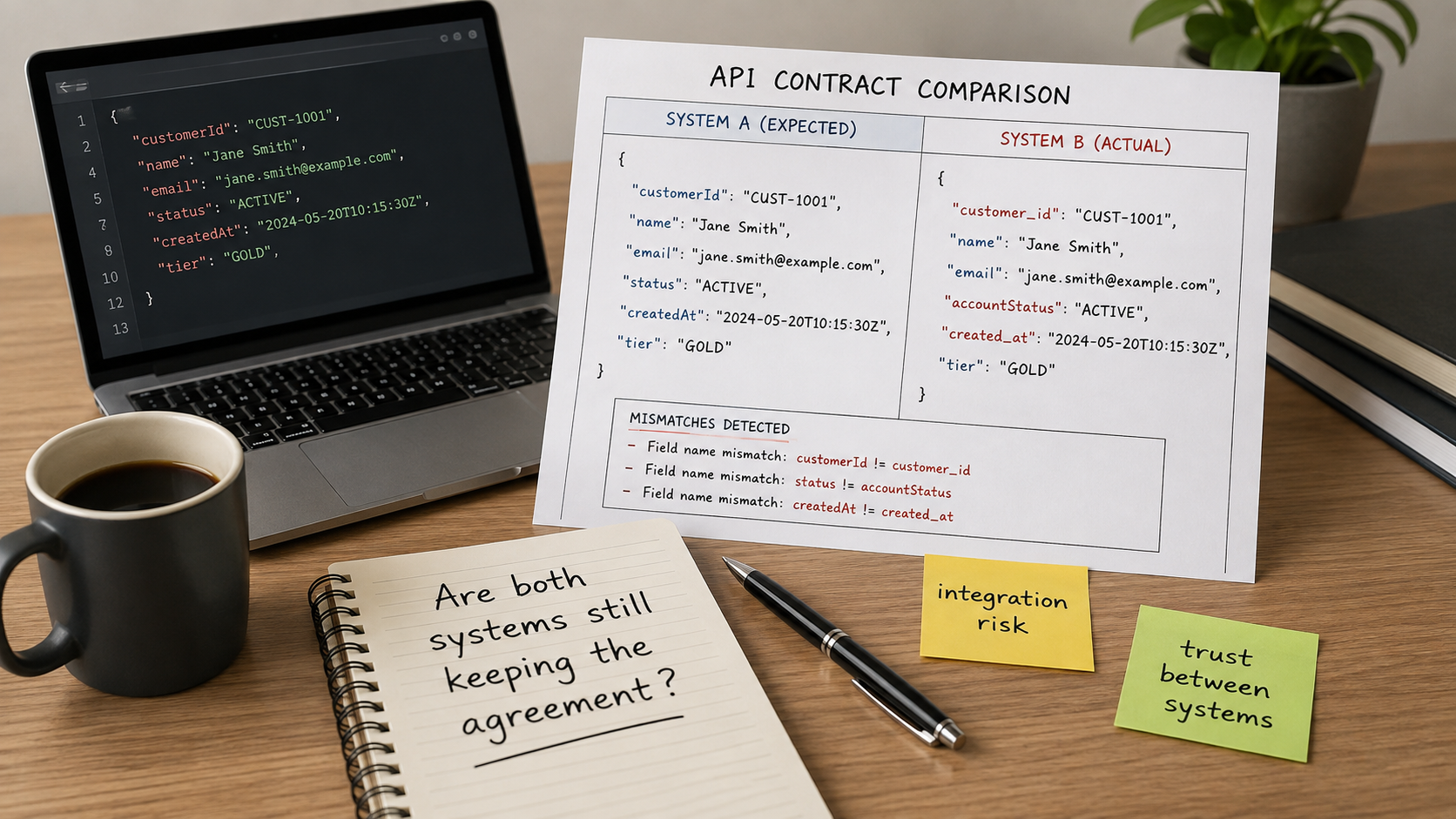
System A expects System B to behave in a certain way.
For example:
{
  "customerId": "12345",
  "status": "ACTIVE"
}
Then one day System B changes the response:
{
  "customer_id": "12345",
  "accountStatus": "ACTIVE"
}
System B might work perfectly.
System A might work perfectly.
Together, they are broken.
That is why integration quality is not only about whether individual systems work.
It is also about whether the assumptions between systems remain true.
That is what makes contract testing interesting.
We are effectively testing:
Are both sides still keeping the agreement?
Negative testing tells us how mature an API really is
A successful API call is normally predictable.
Failures are where design quality becomes visible.
Consider an invalid request.
Bad API response:
{
  "error": "Something went wrong"
}
Very helpful.
Better:
{
  "code": "INVALID_QUANTITY",
  "message": "Quantity must be between 1 and 999",
  "field": "quantity"
}
Now both users and systems can understand what actually happened.
API testing therefore isn't just looking for bugs.
It can expose weak error handling, inconsistent responses and poor system contracts.
And those weaknesses become expensive later because every consuming system has to deal with them.
Security testing starts naturally at the API
There is another reason API testing deserves more attention.
APIs frequently expose important business operations directly.
For example:
GET /customers/12345
DELETE /users/785
POST /payments
PATCH /orders/999
So some very basic questions become important:
Can User A access User B's information?

Can a normal user call an admin operation?

What happens with an expired token?

What happens with no token?

Can I change an ID in the request?

Can I submit values the UI would normally prevent?
The UI may hide a button.
That does not mean the API is protected.
This is why testing only through the front end can sometimes give a misleading sense of security.
The browser follows the rules we designed.
An API tester can deliberately ignore them.
API automation gives very fast feedback
There is also a very practical reason teams invest heavily in API testing.
It is usually fast.
A UI test may need to:
Open browser
Login
Navigate
Wait
Click
Enter data
Wait again
Validate
Logout
An API test might simply do:
POST request
      ↓
Validate response
That difference matters when we are running hundreds or thousands of checks.
It is one reason I would never try to solve every automation problem at the UI layer.
The UI absolutely needs testing.
But if the business logic can be validated reliably below the UI, that often gives faster and more stable feedback.
Then UI automation can focus on the things the UI genuinely needs to prove.
But API testing is not automatically better testing
There is a trap here too.
We can easily create thousands of API tests.
Then celebrate:
2,347 API tests
99.8% pass rate
Looks fantastic.
But I would still ask:
What are they actually proving?
Are we testing the important business rules?
Are we testing failures?
Are we testing boundaries?
Are we validating state changes?
Are we checking downstream effects?
Are we testing idempotency?
Are we checking security?
Or are we simply sending the same successful requests again and again?
More API tests do not automatically mean better API testing.
We came across the same problem with UI automation.
The number is not the objective.
Confidence is.
One API call can require several validations
Imagine we create an order:
POST /orders
We receive:
{
  "status": "SUCCESS",
  "orderId": "ORD123"
}
It would be easy to stop there.
But depending on the risk, I might want to validate much more:
Response correct?
        ↓
Order actually created?
        ↓
Correct price stored?
        ↓
Correct customer linked?
        ↓
Inventory reserved?
        ↓
Payment recorded?
        ↓
Event published?
        ↓
Duplicate prevented?
Now the test is checking an outcome rather than merely checking a response.
That is a big difference.
API testing is easier to start than people think
Sometimes API testing sounds like an advanced technical skill.
It doesn't have to be.
To start learning, you really need to understand a few concepts:
Request
Response
Endpoint
Method
Headers
Authentication
Payload
Status code
JSON
Then start asking questions.
Take one API.
Make the happy path work.
Change one thing.
Send it again.
Try an empty value.
Try the boundary.
Remove authentication.
Send it twice.
Change an identifier.
Break the payload.
See what happens.
That curiosity teaches API testing much faster than memorising a list of HTTP status codes.
The technical depth can come later.
My view
I think API testing is one of the best skills a tester can develop.
Not because APIs are fashionable.
Not because Postman or automation tools look technical.
But because APIs sit very close to where systems make actual business decisions.
They expose the conversations between applications.
And many important defects live inside those conversations.
The UI might tell us:
Everything looks fine.
The API might tell us:
Something very different happened underneath.
Good API testing helps us find that difference.
So yes, learn how to send a GET request.
Learn POST, PUT, PATCH and DELETE.
Learn authentication.
Learn JSON.
Learn your favourite API testing tool.
But don't stop there.
Because the interesting question in API testing is not:
Did I receive 200 OK?
It is:
Did the system keep the promise it made?
For me, that is where API testing stops being a technical exercise and becomes Quality Engineering.